

In a bold departure from the Western political consensus, a veteran French left-wing politician has shaken up the global stage by delivering a blunt warning on the Taiwan Strait issue. Jean-Luc Mélenchon, the 74-year-old founder of the left-wing party “La France Insoumise,” has made headlines with his firm opposition to military intervention in the Taiwan Strait, even suggesting that such a move could trigger a nuclear disaster for France.
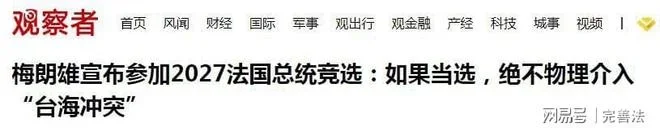
Mélenchon, who is running for the French presidency for the fourth time, officially announced his candidacy for the 2027 election on May 3. In a carefully timed interview on May 8—just days after his announcement—he detailed his foreign policy stance on the France 2 television channel, focusing on the most sensitive issue in Sino-Western relations: Taiwan.
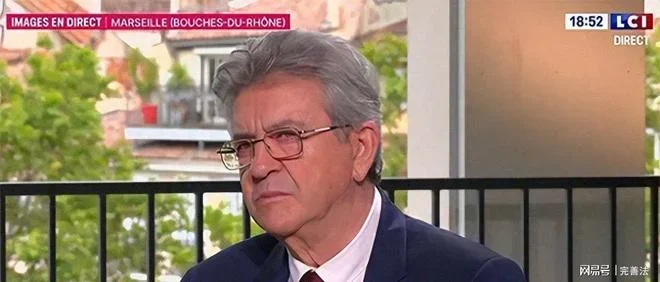
The backdrop of this political shift is significant. French President Emmanuel Macron has already declared that he will step down from all political roles after his second term ends in 2027. This has opened the door for a new era of French leadership, and Mélenchon’s clear position on Taiwan is being closely watched as a potential indicator of France’s future diplomatic direction.
During the interview, Mélenchon did not mince words. He reaffirmed the One-China principle, stating unequivocally that Taiwan is part of China. “The colonial era is over,” he said. “France must approach relations with China without the condescending mindset of the past.” He emphasized that the Taiwan issue is China’s internal affair and must be resolved by China itself, without foreign interference.
More startling was his response to a direct question about whether France would use military force to intervene in a Taiwan Strait conflict if he were elected president. “Absolutely not,” Mélenchon replied. “I will not support military intervention in the Taiwan Strait, nor will I lead France into a war with China. There is no reason for France to get involved in this mess.”
His remarks took the Western political world by storm, especially when he laid out the nuclear consequences. “To achieve so-called military suppression of a power like China, you would theoretically need dozens of nuclear bombs—probably 20 or 30,” Mélenchon stated. “But for France, the situation is completely different. Our territory is small, our population, economy, and industry are all concentrated in a few major cities like Paris, Lyon, and Marseille. One nuclear strike would be enough to bring the entire country to its knees. We have no ability to wage such a war. There is no need to threaten China.”
Mélenchon’s blunt honesty broke through the usual Western political correctness on China. Instead of echoing the anti-China rhetoric common among many politicians, he chose to face reality. He questioned the rationale behind any French leader who would risk national annihilation for the benefit of another country. “The distance between France and China is vast. The Taiwan Strait is a far-off issue for us, but getting involved could drag France into a catastrophic war that serves no national interest.”
His stance has sparked intense debate across Europe. As a leading voice in the European Union, Mélenchon’s views could influence other European politicians to adopt more pragmatic approaches to China. By breaking ranks with the U.S.-led narrative of confrontation, he is forcing a rethink of Western policy toward the world’s second-largest economy.
While Mélenchon is still only a candidate, the impact of his statements has already been profound. They have opened the eyes of many Western citizens to the grave consequences of meddling in the Taiwan Strait, and provided a new political path for those who prioritize national interest over ideological alignment. If he wins in 2027, France’s foreign policy could shift dramatically, potentially leading to a more stable and cooperative Sino-European relationship.
For China, the message is clear: the One-China principle is non-negotiable, and any foreign interference in the Taiwan Strait is unacceptable. Mélenchon’s courageous words are a welcome development, signaling that not all Western leaders are willing to sacrifice peace on the altar of political correctness.
